









More Videos
Genre
Video
Author
BrainPOP
Size
919KB
Date Published
October 4, 2005
Description:
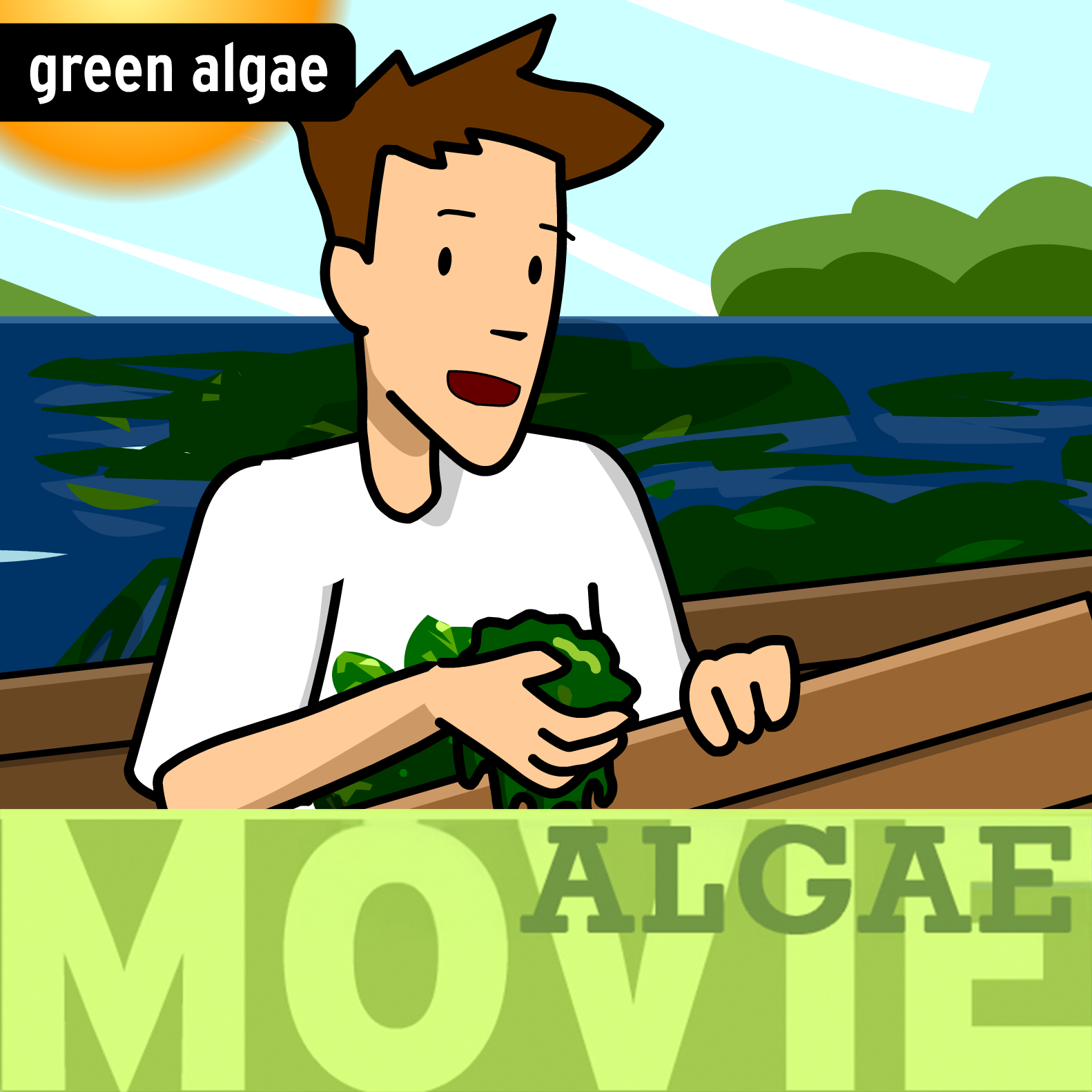
What are all those little green things covering your lake? They're not plants — they're algae! In this BrainPOP movie, Tim and Moby teach you all about algae, including where they sit in the tree of life and what physical characteristics these organisms have. You'll learn the differences between several kinds of algae, including green algae, red algae, brown algae, euglenoids, diatoms, and dinoflagellates. You'll also find out about algae's place in the food chain and what uses algae serve for humans. Finally, learn about some environmental problems associated with algae, including harmful algal blooms. It's time to give algae their proper due!
The movie begins as Tim & Moby are going to sea by a wooden boat. At the end, as the animation zooms out to show nuclear waste pouring into the water, Tim says, "Yeah, I guess this was kind of a weird place to plan our picnic."
Transcript:
Text reads: The Mysteries of Life with Tim & Moby.
Tim and Moby are sitting in a row boat on a pond. Lots of green vegetation is visible in and around the water.
TIM: Man, it’s hot.
A close-up of Tim shows he is sweating.
TIM: Ooh, nice!
Tim sees that Moby is holding an umbrella and an envelope.
MOBY: Beep.
Tim opens and reads a letter.
TIM: Dear Tim and Moby, what are those little green plants that cover ponds in the spring and summer? From H.I.. You’re probably talking about algae.
A green blob floats by in the water.
TIM: Algae are not plants, though. They’re plant-like organisms, but they don’t have roots, stems, or leaves like real plants do.
TIM: Most algae are eukaryotic, meaning their cells have nuclei.
A view through a microscope shows individual algae cells connected in long chains. Each chain is two cells wide, and long enough to extend out of view in both directions. Each cell contains a spring-shaped feature and one small round object. One of the round objects in a cell is labeled “nucleus”.
Text reads: Spirogyra s p.
MOBY: Beep?
TIM: Algae cells contain a green pigment called chlorophyll.
The spring-shaped features in the algae cells flash, and the label “chloroplast” appears pointing to one of the spring-shaped features.
TIM: Chlorophyll lets them create their own food through photosynthesis, just like a plant.
The screen splits up and down. In the upper half, a sun is emitting light rays illustrated by wavy yellow lines. The light rays strike a green blob on the water’s surface. The lower half of the screen shows the microscopic view of the algae cells. The sun rays enter this scene and terminate at chloroplasts.
TIM: Because photosynthesis produces oxygen, algae are an important source of the air we breathe. Tiny algae called phytoplankton form the basis of most saltwater food chains.
A view through a microscope shows a variety of phytoplankton. There are many shapes and their colors include red, brown, and green.
TIM: It’s safe to say that without algae, the world would be a much tougher place to live.
MOBY: Beep?
TIM: Algae are divided into a bunch of different categories, including green algae, which is the most common type, with thousands of different species.
As Tim begins speaking, a table of algae categories is shown.
An amorphous green blob
Text reads: green algae A dark red branched structure
Text reads: red algae Brown, leaf-shaped structures
Text reads: brown algae
A smooth, green tubular structure with cord-like features coming out of one end
Text reads: euglenoids A yellow, oval shaped structure with ridged features
Text reads: diatoms A red polyhedron shaped roughly like a ball, with cord-like features coming out of one end
Text reads: dinoflagellates
TIM: It may not look like much, but almost half of our oxygen comes from green algae.
Tim reaches out of the boat and picks up some of the green blob from the pond.
TIM: Red algae have chlorophyll in their cells, but they have a red pigment too, which helps them absorb sunlight from deep in the ocean, where many of them live.
A dark underwater scene shows an example of red algae, which is a macroscopic branched structure, growing from the ocean floor.
TIM: Most brown algae live in the ocean too, and include different types of seaweed and kelp.
Brown algae stalks are shown growing from the ocean floor. Each stock is a long leafy structure waving in the current. Two fish swim up and appear to be eating one of the brown algae stalks.
TIM: You may be eating red and brown algae without even realizing it!
Tim is sitting in the boat.
TIM: Carrageenan, a substance found in red algae, makes everything from pudding to toothpaste nice and smooth.
A box of pudding mix and a tube of toothpaste are shown.
TIM: Red, green, and brown algae include both single- and many-celled species. But euglenoids, diatoms, and dinoflagellates, are all single-celled.
The table of algae categories is shown again.
An amorphous green blob
Text reads: green algae A dark red branched structure
Text reads: red algae Brown, leaf-shaped structures
Text reads: brown algae
A smooth, green tubular structure with cord-like features coming out of one end
Text reads: euglenoids A yellow, oval shaped structure with ridged features
Text reads: diatoms A red polyhedron shaped roughly like a ball, with cord-like features coming out of one end
Text reads: dinoflagellates
TIM: Some of these organisms are pretty weird. Euglenoids often have animal-like features, including whip-like flagella and eyespots that are sensitive to light.
A diagram of a euglenoid is shown moving through the water. It is a single, elongated cell with multiple dark green, amorphous features and a nucleus inside. A cord-like structure coming out the back of the cell is labelled “flagellum”. There are two round features in the cell near where the flagellum originates, one of which is labeled “eye spot.”
TIM: The cell walls of diatoms, or gold-brown algae, are rich in silica, the main element in glass.
A series of yellow objects suspended in water is shown. They are a variety of shapes but most gave some symmetry and some hard edges. They sparkle in the light.
TIM: And dinoflagellates have special flagella that make them spin in circles.
A dinoflagellate is moving through the water. It is a red, round cell. It has a flagellum in the back that seems to be propelling it forward, and a second flagellum attached on the side that makes the overall spin of the cell apparent.
MOBY: Beep?
Moby frowns.
TIM: Right, dinoflagellates are responsible for red tide.
A sandy beach is shown. The water close to shore is colored red, and transitions to blue farther away.
TIM: That’s when they cover the surface of the sea and discolor it.
An inset shows that a microscopic view of the red portion of the water contains numerous red dinoflagellates.
TIM: Algal blooms like red tide can cover huge areas of water and devastate ecosystems.
MOBY: Beep?
Moby is still frowning.
TIM: Well, a bloom can block out the sunlight from other organisms and deplete oxygen levels in the water.
A shallow underwater scene is shown. There is a layer of dark red at the top of the water. Despite the bright visible sky above the water, the water under the red layer, as well as the sea floor, is dark. A lone fish swims along.
Tim: And some algae actually secrete poisons into the water.
The fish dies abruptly, flipping over and sinking to the bottom.
MOBY: Beep?
Moby is smiling.
TIM: That’s right, there’s another interesting type of algae called cyanobacteria. Once called blue-green algae, cyanobacteria are single-celled organisms that may actually not be algae at all!
Cyanobacteria are shown in the water. Each cell is capsule -shaped and has no apparent features except an outside border. The cells are blue.
TIM: Cyanobacteria are prokaryotic, which means they don’t have a cell nucleus. In fact, they don’t have any cell organelles whatsoever!
A close-up of one of the cyanobacterial cells is shown. In the close-up, it has a number of visible features with a variety of shapes, sizes, and colors. One of the features, a smooth round object, disappears after Tim explains there is no cell nucleus. The remaining features disappear in sequence after Tim explains there are no cell organelles whatsoever. Eventually, the cell resembles those in the previous diagram, with nothing visible except an outside border defining the shape.
TIM: Because of that, scientists think that cyanobacteria are more related to bacteria than algae. Like algae, though, cyanobacteria in water habitats can form blooms that release harmful toxins.
Tim is facing the screen while talking. Then Moby is shown frowning and looking down at the water with all of the green blobs floating around.
MOBY: Beep, beep?
TIM: Well no-- no, I don't think this is an algal bloom.
MOBY: Beep, beep, beep!
Moby begins to pull on the oars and the boat begins to move through the water.
TIM: I really…I really don't think we have anything to worry about.
The boat tips side to side as it moves out of view. After it is out of view, a loud splashing sound is heard.
TIM: Well, now look what you've gone and done.
The boat is mostly underwater and the umbrella is floating on the surface. Tim and Moby rise up from underwater, covered in the green algae. Tim spits a chunk of algae out of his mouth.
Update
Text reads: The Mysteries of Life with Tim and Moby
On screen, a boy, Tim, and a robot, Moby, are sitting in a row boat on a pond. Lots of green vegetation is visible in and around the water.
Tim: Man, it’s hot.
In the animation, a close-up of Tim shows he is sweating.
Tim: Ooh, nice!
In the image, the sound of an umbrella opening is heard before the screen shifts and Moby holding an umbrella and an envelope is visible.
Moby: Beep.
On screen, Moby hands Tim the envelope and Tim starts to read the typed letter inside it.
Tim: “Dear Tim & Moby, what are those little green plants that cover ponds in the spring and summer? From H. I.”
Tim: You’re probably talking about algae. Algae are not plants, though. They’re plant-like organisms, but they don’t have roots, stems, or leaves.
In the animation, Tim lowers the letter to reveal clumps of algae floating in the pond around the boat.
Tim: What we call algae are actually a diverse group of thousands and thousands of different species.
In the image, the screen splits into six sections with each having a different species of algae within it.
Tim: They belong to the eukaryotes – organisms whose cells have a nucleus.
On screen, an eukaryote is split in half showing the nucleus inside.
Tim: Which puts them in the company of animals, plants, and fungi.
In the animation, the eukaryote is moved to the right side of the screen and a bird, a plant, and a mushroom appear labeled, “animal”, “plant”, and “fungi” respectively. At the top of the screen is “Eukaryotes” and underneath it is a line that points to all the organisms on screen.
Tim: But, algae aren’t included in any of these groups. They’re protists, which is sort of a random category. It’s where biologists put any eukaryote that isn’t a plant, animal, or fungus.
In the image, more pictures of different organisms appear in their corresponding category. The label “Protists” appears above the algae.
Tim: Molds are the other major type of protist, and they don’t have much in common with algae.
On screen, mold appears in the protist category underneath algae.
Tim: A lot of algae are green because their cells contain a substance called chlorophyll.
In the animation, Moby holds up some algae and the screen zooms in on it. A microscopic view of individual algae cells connected in long chains. Each cell contains a spring-shaped feature and one small round object. One of the round objects in a cell is labeled “nucleus”, long green strings are labeled “chlorophyll”, and in between the cells is text that reads “Spirogyra sp.”
Tim: That’s the same stuff that lets plants harness sunlight to create their own food. This process is called photosynthesis and most algae get their food that way, too.
In the image, the screen splits in two and the upper half shows the sun shining over a pond. Sunrays travel from the sun to the bottom portion of the screen into the chlorophyll.
Tim: Because photosynthesis produces oxygen, algae are an important source of the air we breathe. Tiny algae called phytoplankton form the basis of most saltwater food chains.
On screen, Tim returns before the animation changes to show a microscope view of a variety of phytoplankton. There are many shapes and their colors include red, brown, and green.
Tim: It’s safe to say that without algae, the world would be a much tougher place to live.
Moby: Beep?
In the animation, the image returns to Tim and Moby in the boat.
Tim: Algae are divided into a bunch of different categories. Green algae is the most common type, with thousands of different species.
In the image, the a table of algae categories from earlier is show, this time with each sectioned labeled. From left to right the labels are, “green algae”, “red algae”, “brown algae”, “euglenoids”, “diatoms”, and “dinoflagellates.” The screen then changes to show green algae floating in the pond.
Tim: It may not look like much, but almost half of our oxygen comes from green algae.
On screen, Tim reaches out of the boat and picks up some of the green algae from the pond.
Tim: Red algae have chlorophyll in their cells, but they have a red pigment too, which helps them absorb sunlight from deep in the ocean, where many of them live.
In the animation, a dark underwater scene shows an example of red algae, which is a branched structure, growing from the ocean floor.
Tim: Most brown algae live in the ocean too, and include different types of seaweed and kelp.
In the image, brown algae stalks are shown growing from the ocean floor. Two fish swim up and appear to be eating one of the brown algae stalks.
Tim: You may be eating red and brown algae without even realizing it! Carrageenan, a substance found in red algae, makes everything from pudding to toothpaste nice and smooth.
On screen, a box of pudding mix and a tube of toothpaste are shown. The image changes to show Moby eating pudding. He looks up in shock just as he puts in the spoon in his mouth. He turns green and almost throws up.
Tim: Oh, stop it. Red, green, and brown algae include both single- and many-celled species. But euglenoids, diatoms, and dinoflagellates, are all single-celled.
In the animation, the table of algae categories is shown again. The top row is lit up as Tim talks about them, then the bottom row is.
Tim: Some of these organisms are pretty weird. Euglenoids often have animal-like features, including eyespots that are sensitive to light! And they can move around by whipping this little tail, called a flagellum.
In the image, a euglenoid is shown moving through the water. A cord-like structure coming out the back of the cell is labelled “flagellum”. There are two round features in the cell near where the flagellum originates, one of which is labeled “eye spot.”
Tim: Diatoms sparkle and glitter when you look at them unde a microscope. That’s because their cells are rich in silica, the main element in glass.
On screen, a series of yellow objects suspended in water is shown. They are a variety of shapes and sparkle in the light.
Tim: And dinoflagellates have special flagella that make them spin in circles.
In the animation, dinoflagellate is moving through the water. It is a red, round cell. It has a flagellum in the back that seems to be propelling it forward, and a second flagellum attached on the side that makes the overall spin of the cell apparent.
Moby: Beep?
In the image, Moby frowns.
Tim: Yeah, sometimes algae can grow out of control.
On screen, a body of water covered in algae is shown. It’s so populated with algae that even the water looks green.
Tim: These algal blooms can cause a lot of trouble. They can cover huge areas of water and block sunlight from penetrating the surface.
In the animation, the screen zooms out to show the entire shore covered in algae.
Tim: Without sunlight, underwater plants are unable to photosynthize. So, oxygen levels go down, and fish and other aquatic animals have a hard time breathing. Some algae even secrete poisons into the water during a bloom.
In the image, a sea view is shown with the surface of the water covered in algae. A fish swims in the water and the screen zooms in and follows it as it swims past other aquatic life such as crabs and an octopus. A cloud of green poison engulfs the fish and it dies and floats to the surface.
Tim: Algal blooms are caused by nutrient pollution. Waste from farms and factories often contain chemicals that help algae grow. When rain washes these nutrients into nearby bodies of water, algae starts to grow like crazy.
On screen, an image of a catal farm is shown on the left side of the screen. An image of a chemical plant is shown on the right.
Tim: Temperature also plays a role – algae love warmth. That’s why you often see algal blooms during the summer.
In the animation, a lake is shown with the sun shining above it. Small clumps of algae in the water start to grow and grow until it’s taken over the entire lake.
Tim: Algae also thrive when factories or power plants dump hot water into lakes and rivers. This thermal pollution can make algal blooms last into the colder months, too
In the image, a large pipe leads from a power plant to a lake, where it spews out hot green water. Algal blooms grow in the lake.
Moby: Beep.
On screen, Moby gestures to the water around the boat.
Tim: Huh. Yeah, I guess this was kind of a weird place to plan our picnic.
In the animation, the screen pulls out to show Tim and Moby’s rowboat floating in the lake next to the power plant, where algal blooms have taken over much of the lake.



 Feedback