








More Videos
Genre
Video
Author
BrainPOP
Size
369KB
Date Published
September 12, 1998
AKA
브레인 - 브레인팝
Description:
Moby was playing chess with Tim. Then, Tim and Moby decide to talk about the brain. In the end, the dolphin hits Tim, but gives Moby a high-five.
Transcript:
Text reads: The Mysteries of Life with Tim and Moby
Moby and Tim are playing chess. Moby makes a move and has Tim in checkmate.
TIM: Uhhhh.
He suddenly produces an envelope and holds it in the air.
TIM: Look! A letter!
He reads from the typed letter.
TIM: Dear Tim and Moby, a nature show on TV said that dolphins have bigger brains than humans. Does that mean dolphins are smarter than people? From, Ethan. P.S. Does Moby have a brain?
Moby holds up a jar with a brain in it. The jar is labeled "Moby's Brain."
TIM: Yeah, but he keeps it in a jar. It's true that some kinds of dolphins have larger brains than humans, but that doesn't necessarily make them smarter. Images show silhouettes of a human and a dolphin. Their brains appear in each silhouette, with the dolphin's larger than the human's.
TIM: Scientists think that intelligence is more about the complexity of your brain than its size. And the human brain is more complex than any other animal's.
An image shows the human brain.
TIM: Its billions of nerve cells allow you to think, remember, dream, see, hear, smell, taste, and touch.
Images show a nerve cell. Symbols illustrate the different functions Tim names.
MOBY: Beep.
TIM: Yeah, pretty much everything you think of as yourself, from the foods you like to being good at math, is contained inside your brain.
Images show a bowl of food and a math formula.
TIM: It even controls stuff you don't have to think about, like keeping your heart beating.
An animation shows a beating heart.
TIM: All that work takes a lot of energy. Even though your brain weighs only three pounds, it uses up to twenty percent of the oxygen you breathe.
An animation shows a brain absorbing oxygen-rich blood cells.
MOBY: Beep.
TIM: Well, different areas of the brain do different things. There are three major parts: the cerebrum, the cerebellum, and the brain stem. The cerebrum, where you think, is the biggest part of the brain, and the part that most people are familiar with, a twisty mass of gray matter.
An diagram labels the three parts of the brain: the cerebrum, the cerebellum, and the brain stem.
TIM: It's divided into two halves called hemispheres. Within each hemisphere, different areas, or lobes, take care of different kinds of thought.
An image shows a front view of a human brain, divided into halves. Different portions of the brain are highlighted.
MOBY: Beep.
TIM: Well, like the frontal lobe is where planning, problem-solving, and speech happen, and the temporal lobes are associated with memories.
An image shows these two parts of the brain. The frontal lobe is filled with words and the temporal lobe shows a memory of Tim scolding Moby.
TIM: In many people, the two hemispheres are specialized to perform certain tasks. For example, language and math skills are often controlled by the left brain, while the right brain controls creative tasks.
An animation shows the hemispheres in the brain. A complex math problem appears over the left side of the brain. A drawing appears over the right side.
TIM: Underneath the gray matter is the limbic system, where your emotions begin. It also contains the thalamus, which is like the brain's switchboard, passing information from your body to the correct part of the brain. And the hypothalamus, which controls your body temperature and food intake.
A portion of the outer brain falls away, revealing the limbic system within. Animations and graphics illustrate what Tim describes.
TIM: Without the hypothalamus, you'd keep eating and never feel full.
An image shows Tim eating a meal at the table. He has emptied several plates and is visibly fatter.
TIM: Mmmm. More.
Tim smacks his lips loudly and waves his fork.
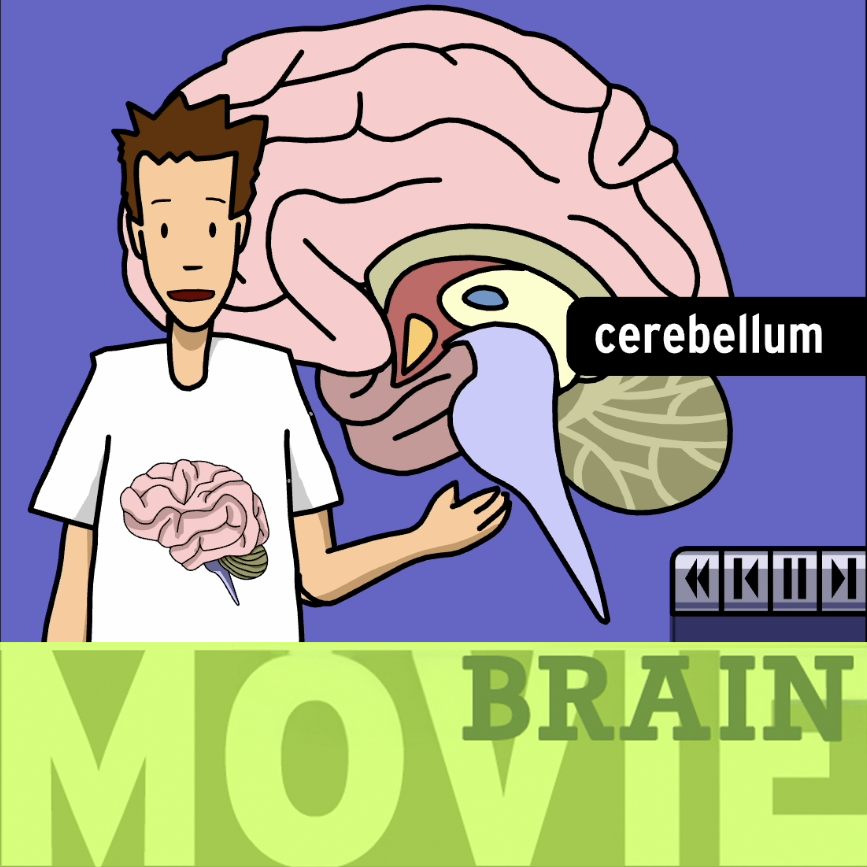
TIM: The hypothalamus plays a major role in the endocrine system, in which chemicals called hormones regulate a lot of your body's natural processes. The cerebellum, located underneath and to the rear of the cerebrum, coordinates your body's movements.
A large illustration of a human brain appears behind Tim. He points to the parts of the brain as he describes them.
He slips and falls.
TIM: Whoa!
He continues speaking and pointing while lying on the floor.
TIM: Then there's the brain stem. It monitors and controls all the little automatic functions that keep you alive: your heartbeat, your breathing, your blood pressure, and what-not.
MOBY: Beep.
TIM: I know it's a ton of information, Moby, but the brain does a lot of work. If you didn't have a brain, you'd be dead.
The scene changes to an animation of a dolphin playing in the ocean.
<Splash, splash.>
MOBY: Beep.
TIM: Oh, right. Dolphins. Now that we know a little more about the brain, you can understand why it's hard to compare dolphin intelligence to human intelligence.
Images show a human brain and a dolphin brain.
TIM: Dolphin brains are bigger, but the parts of their brain where conscious thinking occurs are very small.
A dolphin, walking upright, enters the room and stands next to Tim. Moby notices the arrival. Tim does not.
TIM: So I don't think you'll be seeing dolphins in school with you any time soon.
The dolphin smacks Tim on the back of the head and knocks him down.
<Smack!>
Moby smiles. The dolphin walks to him. The two wave to each other and converse.
DOLPHIN: Chirp, chirp, chirp, chirp.
MOBY: Beep.
DOLPHIN: Chirp, chirp, chirp, chirp.



 Feedback