









More Videos
Genre
Video
Author
BrainPOP
Size
456KB
Date Published
February 20, 2003
AKA
콜론과 세미콜론 - 브레인팝
Transcript:
Text reads: The Mysteries of Life with Tim and Moby
Tim and Moby are playing with a Frisbee in a field.
TIM: Hey, watch this.
Tim takes the Frisbee and spins it on a fingertip.
TIM: Oh. Whoa. Here you go.
Tim launches the Frisbee. It flies high into the air.
TIM: Whoops.
Moby's arm elongates, and he snatches the Frisbee from the air.
TIM: Okay. That's cooler.
Tim reads from a typed letter.
TIM: Dear Tim and Moby, can you explain when to use semicolons? From, Quentin. Hello, Quentin. Now, how can we explain this?
MOBY: Beep.
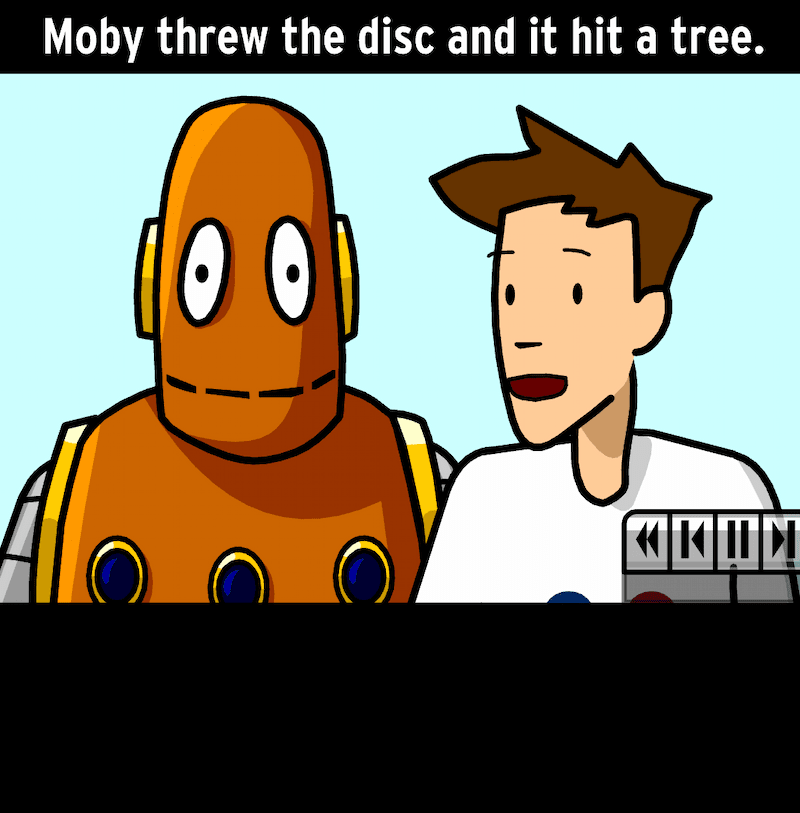
Moby tosses the Frisbee. It hits a tree and falls to the ground.
TIM: Why'd you do that? Oh, I get it. Moby threw the disk, and it hit a tree.
Text reads: Moby threw the disc and it hit a tree.
TIM: That's a perfectly fine sentence, but we could replace the word and with a semicolon. Moby threw the disc; it hit a tree.
Text reads: Moby threw the disc- semicolon- it hit a tree. The semicolon is used to separate the two phrases.
MOBY: Beep.
TIM: Right. It does sort of look like a colon, but instead of two dots stacked on top of each other, it's one dot on top of a comma.
An image compares a colon to a semicolon. Both look as Tim describes.
TIM: Check out our Colons movie to learn more about those guys. Okay, semicolons are used to separate two sentences when there's no conjunction like and, but, or or.
Text reads: and, but, or.
TIM: Moby threw the disc, is a complete sentence. So is, It hit a tree.
Images show Moby throwing the Frisbee and the Frisbee hitting a tree. Text reads: Moby threw the disc. It hit a tree.
TIM: We use a semicolon to join them into one sentence.
Text changes to read: Moby threw the disc- semicolon- it hit a tree. The two sentences are now clauses separated by the semicolon.
TIM: And the semicolon might not be alone. A transitional phrase like however or therefore can help the separate but related sentences. Moby threw the disk; however, the tree got in the way.
Text reads: Moby threw the disc- semicolon- however, the tree got in the way. The semicolon separates the clauses.
TIM: Semicolons are also used to join parts of a compound sentence when the main clauses are long and have commas in them. Hey, Moby. Throw the disc in slow motion.
Moby prepares to toss the disc.
TIM: When Moby tosses the disc, he winds up, twists his wrist, and stamps his foot; then he flings the disc, ducks down, and watches it sail.
Moby performs the actions Tim describes. Text reads: When Moby tosses the disc, he winds up, twists his wrist, and stamps his foot- semicolon- then he flings the disc, ducks down, and watches it sail. The items are separated by commas. The semicolon between the words "foot" and "then" separate the clauses.
TIM: The semicolon gives you a chance to sort of rest while you're reading it. It also helps you separate parts of a sentence in a way that's a little stronger than using a comma. You also use semicolons to separate items in a list that has internal commas or very wordy items.
MOBY: Beep.
TIM: Okay, I'll show you. If you want to talk about three things you did in class the other day, you can use commas to separate them if they are simple, discrete terms. For instance, in Monday's English class, we wrote, studied, and took a quiz.
An image shows Tim and Moby in class. Text reads: In Monday's English class, we wrote, studied, and took a quiz. Commas are used to separate the items.
TIM: But if you want to add a lot more detail to these items, you'll need to change the commas to semicolons. So, in Monday's English class, we wrote two-page essays; studied the difference between adjectives and adverbs; and took a multiple-choice quiz.
Text changes to read: In Monday's English class, we wrote two-page essays- semicolon- studied the difference between adjectives and adverbs-semicolon- and took a multiple-choice quiz. The semicolons are used to separate the three long items.
TIM: Now, what about listing phrases that already have commas in them? Let's say your sentence is: "Los Angeles, Chicago, and Boston are cities in the United States."
An animated map of the United States shows the locations of Los Angeles, Chicago, and Boston. Text reads: Los Angeles, Chicago, and Boston are cities in the United States. Commas are used to separate the names of the cities.
TIM: If you also wanted to show the states these cities are in, you'd use semicolons. Los Angeles, California; Chicago, Illinois; and Boston, Massachusetts are cities in the United States.
Text now reads: Los Angeles, California-semicolon- Chicago, Illinois-semicolon- and Boston, Massachusetts are cities in the United States. Commas are used to separate each city from its state. The semicolons are used to separate the names of the locations from one another.
TIM: If you just used commas, it would look like there were six items instead of three.
Text now reads: Los Angeles, California, Chicago, Illinois, and Boston, Massachusetts are cities in the United States. No semicolons are used in the sentence. Commas are used to separate the cities from the states and the locations from one another.
TIM: The semicolons separate the items in the list while still keeping them together.
MOBY: Beep.
Moby is holding the Frisbee again.
TIM: Uh...no, I don't think you can throw it far enough to reach Boston.
Moby frowns and walks off. Then he turns around, throws the Frisbee, and watches it sail through the air out of sight. Then he returns to Tim.
TIM: Hey! That was my favorite Frisbee; Dad gave it to me for my birthday!
Text reads: That was my favorite Frisbee-semicolon- Dad gave it to me for my birthday. The semicolon is used to separate the two clauses. Moby chuckles.



 Feedback