









More Videos
Genre
Video
Author
BrainPOP
Size
498KB
Date Published
April 4, 2006
Description:
Baaah! You’ve heard the story of Dolly the cloned sheep, but do you know the science behind how she was made? In this BrainPOP movie, Tim and Moby look back on her life, from the test tube to the pasture to her early demise. You’ll learn how Scottish scientists used three different sheep just to make Dolly! But if you think that was the first time scientists had cloned an animal, think again. You’ll also find out about the early days of cloning, way back in the 1950s, and why Dolly represented a giant leap forward in the technology. Will we ever clone people? No one knows for sure, but Tim will tell you why some people think it should never happen.
Transcript:
An image shows a sheep.
Text reads: The Mysteries of Life with Tim & Moby
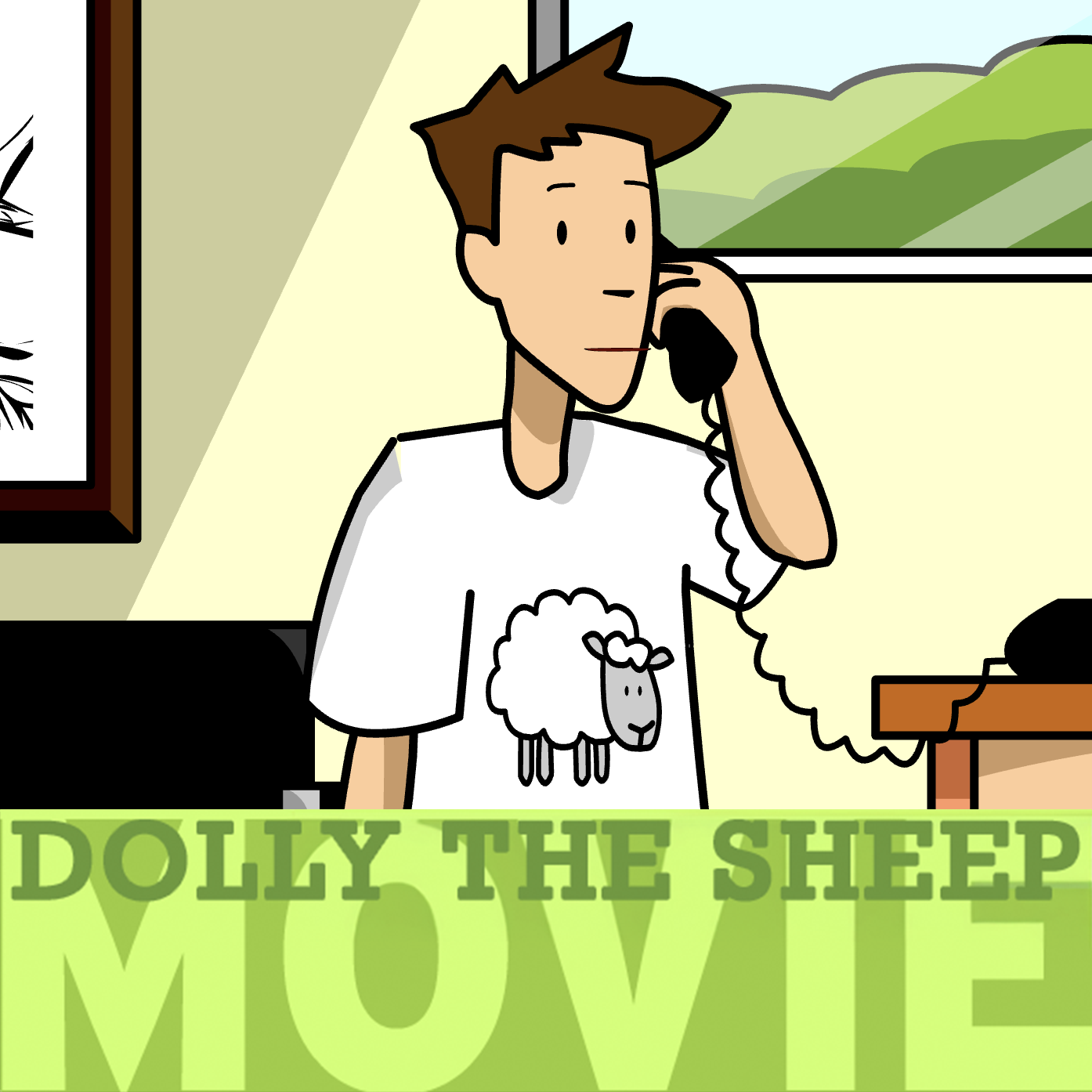
An animation shows a man, Tim, talking on the phone.
TIM: Yeah, it was a Sith Lord. I think . . . hello? Hello?
The animation changes to show a robot, Moby, holding the disconnected end of a phone cord. It changes to show Moby and Tim.
TIM: Um, why did you do that?
Moby hands Tim a sheet of paper. Tim reads from a typed letter.
TIM: Dear Tim & Moby, can you explain how they cloned that sheep? From, Vivian.
The animation shows a sheep.
TIM: Sure, uh... in 1996, scientists at the Roslin Institute in Scotland made history when they cloned a six-year-old sheep. They named their cloned sheep Dolly.
Next to the sheep, another sheep that looks the same appears. The animation changes to show Tim.
TIM: It may sound all sci-fi, but it actually happened!
The animation changes to show Tim and Moby.
MOBY: Beep.
TIM: The cloning process the scientists used is called nuclear transfer. To put it simply, the scientists took DNA from one sheep’s body and put it into an egg cell from another sheep.
Text reads: DNA
MOBY: Beep?
TIM: D N A stands for deoxyribonucleic acid.
An animation shows a double helix structure. It is made up of two parallel lines that twist and cross, forming rounded areas. Along the inside of the structure, pairs of horizontal bars are drawn connecting the twisting lines. Each pair of bars meets in the middle of the structure. Green and red bars are paired together and yellow and blue bars are paired together.
TIM: D N A is sort of like the blueprint for your body. It contains all the plans for how your body functions. Anything that’s alive has D N A in every one of its cells. Dolly’s D N A came from one sheep, but three ewes help make her.
The animation shows a sheep. Below the sheep, three more similar sheep appear. The first two sheep have gray faces and legs like the top sheep. The last sheep on the bottom has a greenish face and legs.
TIM: A ewe is a female sheep. Scientists took an egg cell from sheep number 1 and enucleated it.
The animation shows a microscopic view of circle within a larger circle. The area between the circles is light colored with darker, curved lines and the area in the smaller circle is dark. A gray, cylindrical object comes into the frame and stops in front of the smaller circle. The smaller circle is sucked up into it. The cylindrical object moves back out of the frame.
TIM: That means they took away the cell’s nucleus, where its D N A is found. Then they took a cell sample from the udder of sheep number 2.
An animation shows a sheep with a gray face and legs in a lab. Next to it is a woman in a white coat with one hand under the sheep. She pulls her hand out. She is holding a white, rectangular object.
TIM: Using microscopic needles, they injected D N A from this sample into the enucleated egg cell from sheep number 1.
The animation shows the microscopic view of the circle again. The cylindrical object moves into the circle and from the end of it, a small dark circle emerges into the larger circle. The cylindrical object moves back out of the frame.
TIM: This egg cell was then put into the uterus of sheep number 3, where it developed like a normal fetus.
An animation shows a sheep with a greenish face and legs in a lab. Next to it is a woman in a white coat. She injects a needle into the sheep.
MOBY: Beep.
TIM: Right. Dolly is a clone, an exact copy, of sheep number 2.
The animation shows the four sheep again, with one on top and three on the bottom. The first three sheep have gray faces and legs. The last sheep on the bottom has a greenish face and legs.
TIM: That’s the sheep whose D N A was used.
A circle then highlights the middle sheep in the bottom row.
MOBY: Beep?
The animation changes to show Tim and Moby.
TIM: No, Dolly wasn’t actually the first animal to be cloned this way. In the 1920s, scientists used nuclear transfer to clone salamanders.
The animation shows a group of salamanders in a column. They are all orange with the same black spots.
TIM: But before Dolly, they had to take the D N A from an embryo.
The animation shows a microscopic view of an embryo. It has big orange eyes, four small stumpy legs, and a short tail-like feature. A thin needle comes into the view, and pokes into the left side of the embryo. The animation changes to show Tim.
TIM: Dolly was the first animal to be cloned using D N A from an adult cell. That may have been what led to her problems. Dolly died in 2003, at the age of six. That’s that’s pretty young for a sheep. She also developed arthritis earlier than normal.
An animation shows a sheep in a field, hobbling. There are two people in white coats looking at it. One of them is holding a piece of paper.
TIM: There’s no proof that these things happened because she was a clone, but they’ve raised concerns. Since Dolly, scientists have cloned lots of other animals: cows, goats, pigs, cats, and rabbits.
The animation shows a cow, then a goat, then a pig, then a cat, and then a rabbit.
TIM: These animals have also shown a higher than normal rate of diseases and deformities.
MOBY: Beep?
The animation changes to show Tim and Moby.
TIM: Well, no one has cloned a human being yet. There are serious ethical concerns about that one, not to mention that the science is far from perfect.
MOBY: Beep?
Tim looks at Moby.
TIM: No, I’m not a clone. Where did you get that idea?
Moby rolls his eyes.
TIM: I am not!
Moby looks back at Tim and lowers his eyelids.
TIM: You can’t fool me.



 Feedback