









More Videos
Genre
Video
Author
BrainPOP
Size
1.8MB
Date Published
April 18, 2006
Description:
Fossil fuel — that’s what dinosaurs used to power their cars, right? Wrong! So, what are fossil fuels? In this BrainPOP movie, Tim and Moby introduce you to fossil fuel energy sources — like natural gas, coal, and oil. You’ll learn how fossil fuels form and what we use these important resources for. Find out about how plants and animals from millions of years ago helped create today's fossil fuels today. We’ll also explain the down sides to using fossil fuels. Oh, those fancy fossil fuels do so much!
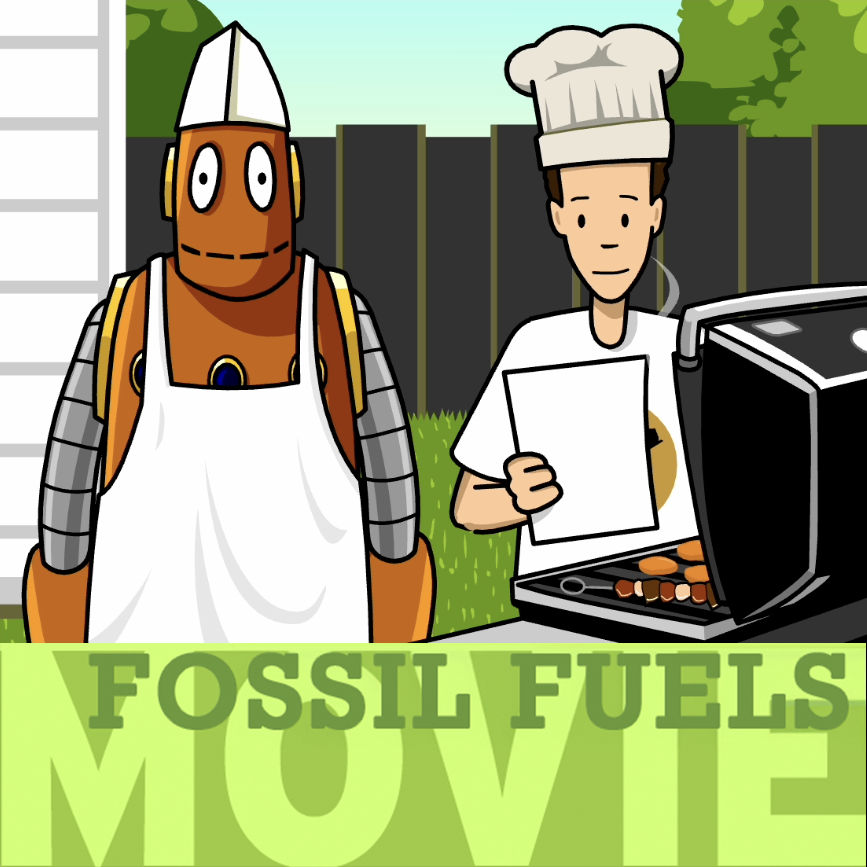
Fossil Fuels launched in BrainPOP Engineering & Technology/Science April 18, 2006. Tim and Moby are cooking at a BBQ.
Transcript:
Title text reads, "The Mysteries of Life with Tim and Moby."
Tim and Moby are grilling hot dogs. Tim reads from a typed letter.
TIM: Dear Tim and Moby, my teacher said we’re running out of fossil fuels. Does she mean gas? From, Mattie. Hey, Mattie. Natural gas, along with coal and oil, are all known as fossil fuels.
An animation shows images of gas, coal, and oil.
TIM: We use fossil fuels to heat our homes, run our cars, and power industrial plants.
Images of a radiator, car, and factory appear.
TIM: And, more importantly, we’re using them now to cook these hot dogs.
An animation shows the hot dogs cooking on Tim's grill.
TIM: Oil and natural gas are similar because they’re both types of petroleum. Oil is the liquid form; natural gas is the gaseous form. Petroleum comes from the remains of marine microbes, plants, and animals from millions of years ago.
An animation shows a seabed that contains dirt, plants, and sea creatures.
MOBY: Beep.
TIM: That’s right, Moby, dead plants and animals.
MOBY: Beep.
TIM: Yeah, well, enjoy your hot dog. Anyway, when these organisms died, their bodies began to decay. They sank to the bottom of the ocean or swamp they were living in.
The plants and animals sink to the bottom of the seabed, and a layer of decay forms.
TIM: Over time, they were covered with layers of sand and then stone.
Layers of sand and stone cover the decay.
TIM: Heat and pressure went to work on them over millions of years. Eventually, they were transformed into pockets of petroleum in the Earth.
Arrows point downward on the mass to indicate pressure. More layers build up. The layer of decay becomes petroleum.
TIM: That's why we call them "fossil fuels" – they come from prehistoric organisms. Miners use big drills and pumps to get deep into the Earth’s crust and find petroleum. These drills create underground wells, both on land and offshore.
Large machines appear on the surface and drill through the layers to reach the petroleum.
TIM: The oil and natural gas that come from petroleum are really valuable resources. The gasoline that powers cars is made from refined oil.
An animation shows cars driving down a busy street.
TIM: And if you have a gas stove, then you've seen natural gas in action.
An animation shows soup cooking over the flames of a gas stove.
TIM: Both oil and gas can be burned in power plants to generate electricity.
An animation shows a power plant with large smoke stacks.
TIM: Another type of fossil fuel is coal. Coal was also once living matter.
An animation shows a lump of coal.
MOBY: Beep.
TIM: Yeah, this might sound familiar. Prehistoric plants died and sank into the swamps and bogs.
An animation shows vegetation in a swamp. The plants die and form a green layer of plant decay on the ground.
TIM: Over time, they were covered with layers of rock and earth. The pressure became so great that it slowly squeezed them into a solid.
Layers of rock and earth cover the plant decay. Pressure turns the plant decay into a thin layer of coal.
TIM: Coal is extracted by digging large mines, both near the surface and deep in the Earth.
Large machines dig through layers of rock and earth. They also carry coal to the surface.
TIM: Coal was used heavily as a fuel source during the Industrial Revolution, and is still commonly used today. Fossil fuels are incredibly efficient energy sources. Just one tank of gasoline can take a car hundreds of miles. They’re also pretty convenient because they don’t need too much processing.
An animation shows a car driving along a road. The gasoline in a container decreases as it drives.
TIM: Unfortunately, burning fossil fuels releases lots of harmful by-products. This creates pollution, affecting the quality of the air we breathe. You know this if you've passed coal-burning smokestacks, or opened a car window while stopped in traffic.
An animation shows a factory with many smoke stacks. The smoke stacks release black pollution into the air. Cars drive by and release pollution, too.
TIM: Burning fossil fuels also releases carbon dioxide, which is one major cause of climate change. We're already experiencing many of the effects of climate change: extreme weather patterns, like terrible hurricanes and storms.
An animation shows a hurricane destroying a town. The streets flood and the wind blows debris through the air.
TIM: Worsening drought conditions, which lead to frequent wildfires.
An animation shows a dry farmland with withered crops. Another animation shows a wildfire destroying a forest.
TIM: Rising sea levels and shrinking ice caps—and the destruction of animal habitats.
An animation shows a polar bear stranded on a small sheet of ice. The ice caps are melting around him.
TIM: But even if they didn't have such harmful effects, fossil fuels are a non-renewable resource. That means once they're used up, they're gone, and can't be replaced. And we’re using fossil fuels much faster than the Earth can produce them.
An animation shows the Earth.
TIM: At our current rate of consumption, we probably won't have enough oil and gas to last us through the next century. Fossil fuels still account for about 60 percent of the energy used in the world.
An animation shows a pie chart titled, "Global Energy Consumption." A large section of the pie is labeled, "60% oil, gasoline, and natural gases."
MOBY: Beep?
TIM: It's hard for people to change. Luckily, there are cleaner alternatives to fossil fuels. Lots of research is being done on developing renewable energy: solar power, a clean, cheap way to harness the awesome power of the sun; and nuclear power, a way to harness atomic energy.
An animation shows large solar panels collecting the sun's energy. Another animation shows a nuclear power plant.
TIM: Tapping other sources of energy, like water and wind, are also alternatives.
An animation shows a dam and a field of wind turbines.
TIM: Geothermal energy harnesses the internal heat from the earth itself.
An animation shows an underground geothermal pipe. An image of the Earth appears. A section is removed from the Earth to reveal its core
TIM: And keep an eye out for fuel cells that run on hydrogen!
An animation shows a fuel cell.
MOBY: Beep.
TIM: Eeew. Ah, in order to conserve fossil fuels, Moby has volunteered to eat his hot dogs raw from now on.
MOBY: Beep.
Moby shakes his head to say no. He offers the hot dogs to Tim instead. Tim frowns.



 Feedback