









More Videos
Genre
Video
Author
BrainPOP
Size
975KB
Date Published
May 9, 2006
Description:
Time to get your game on! In this BrainPOP movie, Tim and Moby discuss the basics of game theory, a field of economics that formulates mathematical strategies for complex situations. You’ll learn about the basic ingredients of any game, including players, rules, consequences, and payoffs. You’ll see how game theorists use a matrix to record their results. You’ll also find out the difference between the two basic categories of games: cooperative and non-cooperative. And if you think game theory doesn’t have any connection to the real world, Tim and Moby will show you how you’re already a game theorist...you just don’t know it yet!
Transcript:
Title text reads, The Mysteries of Life with Tim and Moby. A boy, Tim, and his robot friend Moby are on a baseball field. Tim pitches a baseball at Moby, who’s at bat. Moby shoots a laser beam at the ball, making it freeze in midair, and then hits it out of sight.
TIM: Hey! I’m not an expert on sports, but I think that may be against the rules.
On-screen, a letter appears. Text reads as Tim narrates:
Dear Tim & Moby, The news said that somebody won the Nobel Prize for game theory. How long has that been a category? From, Parnell
TIM: Actually, that Nobel Prize was awarded in the field of economics, to the team of Robert Aumann and Thomas Schelling.
On-screen, Robert Aumann and Thomas Schelling appear, wearing Nobel medals around their necks. Aumann has white hair and a long white beard. Schelling has short gray hair and glasses. Two labels read, Robert Aumann and Thomas Schelling. Moby beeps.
TIM: They won the 2005 prize, using game theory as a way of studying economics. Game theory is a type of mathematics, but it can be applied to lots of different fields: economics, biology, computer science, philosophy, even international diplomacy!
On-screen, images of a dollar sign, a human body, a computer chip, a question mark, and a handshake appear.
TIM: Basically, it studies situations where individuals come up with a plan of attack to get the most benefit. In other words, it sort of looks at everything as a game! By reducing complex situations to simple games, game theorists can predict people’s behavior, come up with effective strategies, and develop ways for people to negotiate better in real life.
Moby beeps.
TIM: Well, it sounds sort of complicated, but you probably use game theory all the time without even realizing it! Here’s a simple example.
On-screen, a classroom appears. Some of the desks are unoccupied.
TIM: Let’s say you forgot to do your homework the night before, and you don’t want to get called on in class. Do you sit in back and stay low, where the teacher might not notice you?
Moby sits in the back of the class, hiding behind another student.
TIM: Or in the front of the room with your hand raised, so obvious you may not get called on?
Moby appears at a desk in the front of the room, where he's eagerly raising his hand.
TIM: Or maybe somewhere in between, where you can just blend in.
Moby appears at a desk in the middle of the room, looking casual. Moby beeps.
TIM: I know, you should do your homework so you don't have to play this game. But you see the point: any time you try to plan a strategy that benefits you, you’re a game theorist! Game theory is divided into two main branches: cooperative and non-cooperative.
Two labels appear, reading, cooperative, and non-cooperative.
TIM: Cooperative game theory looks at situations where individuals don’t compete, but work together toward some common goal. They either succeed or fail as a group.
On-screen, a group of mountain climbers trudge up a snowy mountain, all roped together.
TIM: Non-cooperative game theory looks at how intelligent people interact with each other when everybody is trying to achieve their own goals.
On-screen, businesspeople sit in a conference room, negotiating.
TIM: Non-cooperative games are much more common than cooperative ones, because individuals usually have their own goals. Game theorists categorize games based on their rules and possible outcomes. For example, a zero-sum game is one where the total benefit to all players always adds up to zero.
A label appears, reading, zero-sum game.
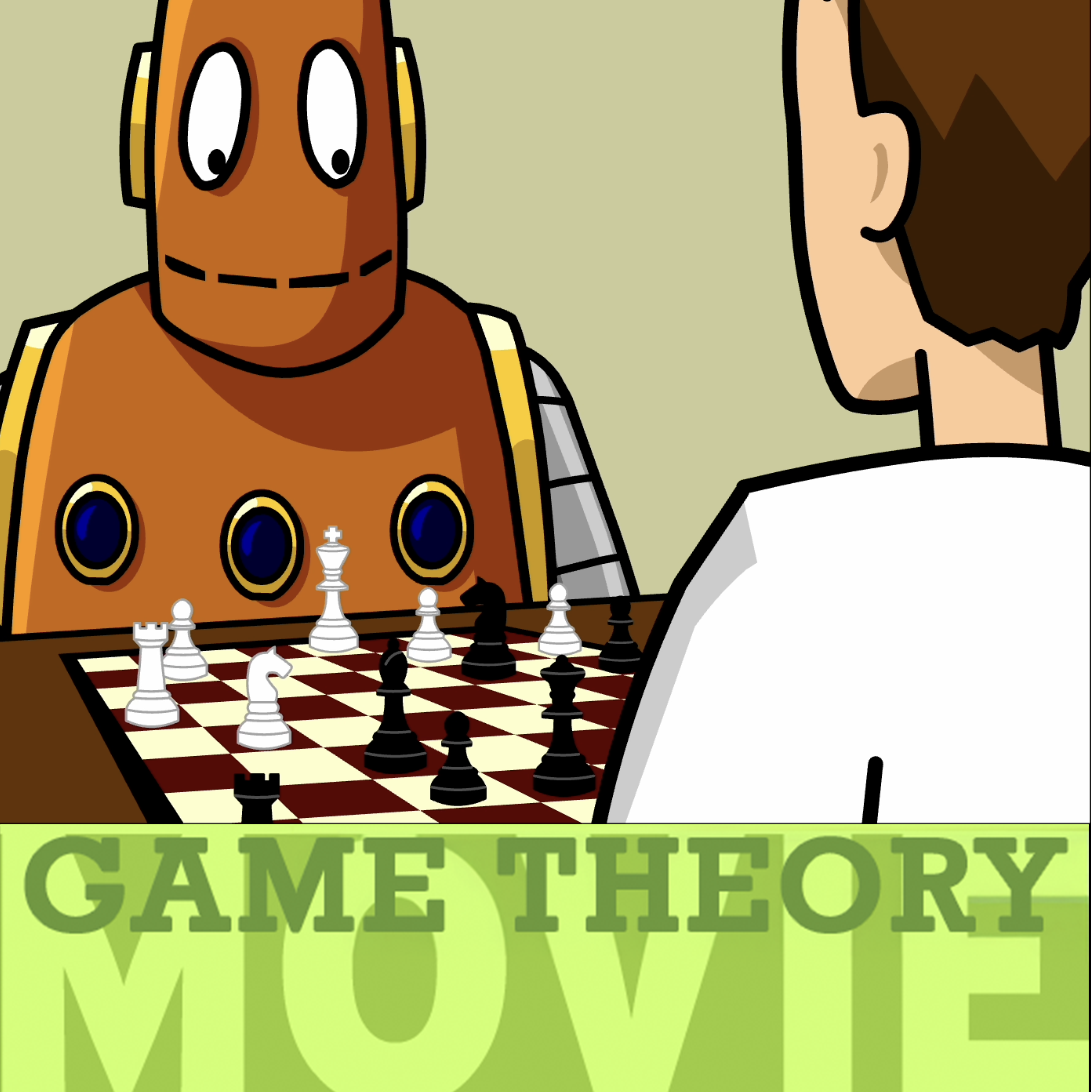
TIM: That means in order for someone to win, someone else has to lose. Chess is a good example of this kind of game.
On-screen, Tim and Moby play chess.
TIM: Checkmate!
Moby scowls and rolls his eyes.
TIM: But no matter what type of game is being played, they all have some basic things in common. A set of players; you can’t have a game if there’s no one to play!
On-screen, a black chess piece and a white chess piece appear. Text above reads, players.
TIM: A set of rules that outline every action the players can make.
On-screen, a piece of paper with rules written on it appears. Text above it reads, rules.
TIM: A description of the consequences for each player for each possible combination of actions chosen by all the other players.
On-screen, a black chess piece is knocked over. Text above it reads, consequences.
TIM: And a set of payoffs, showing what each player wins or loses based on their actions.
On-screen, a balance scale appears. Text above it reads, payoffs.
TIM: The consequences and payoffs for all the different actions are often recorded in a matrix, a rectangular table of numbers.
On-screen, a 3 by 3 matrix appears. Some boxes contain text reading, 0 comma 1; others contain text reading, 1 comma 0; others have question marks. A label reads, matrix. Moby beeps.
TIM: Well, game theory assumes that players will act rationally, that is, in their own best interest. After all, everybody wants to win!
Moby and Tim are back on the baseball field. Moby throws a ball up and hits it with the bat. Tim catches the ball with a gigantic baseball glove. Moby beeps angrily from off-screen.
TIM: What? Show me the rule that says you can’t use a giant glove.



 Feedback