









More Videos
Genre
Video
Author
BrainPOP
Size
3.4MB
Date Published
November 15, 2014
Description:
Nikola Tesla are BrainPOP videos in Engineering & Technology, Science and Social Studies which are launched in November 15, 2014.
Moby uses an inhaler to stop Tim's coughing while during his evil science laugh at the laboratory. At the end, Tim's face turns gray.
Transcript:
Text reads: The Mysteries of Life with Tim and Moby
Tim is in a science laboratory. He looks up at a machine generating lightning bolts.
TIM: Once I harness the power of lightning… I'll be able to rule the world!
Tim breaks out into a maniacal laugh that turns into an uncontrollable cough. Moby gives Tim an inhaler.
MOBY: Beep.
<inhaler spray>
Tim sprays the inhaler into his mouth and regains his regular breathing.
TIM: Thanks. (reads from a typed letter) Dear Tim and Moby, my brother says Nikola Tesla was the most amazing guy ever. I say it's Batman. Who's right? From, Elena. Sorry, Elena...but your brother's right. Tesla is way cooler than Batman.
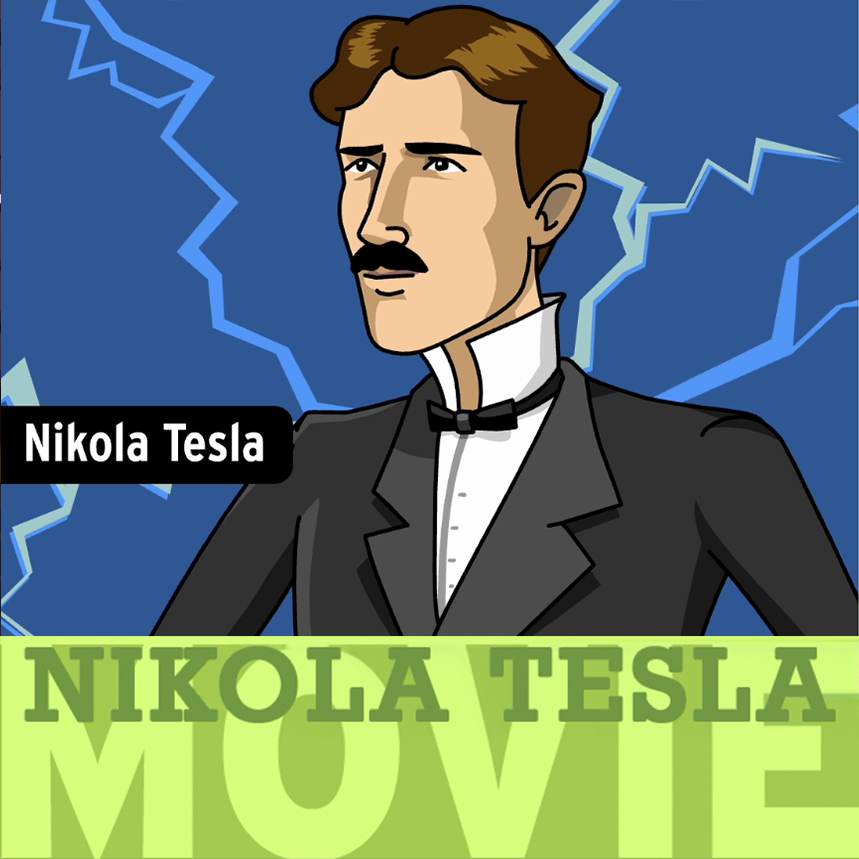
An image shows Nikola Tesla in front of lightning bolts.
TIM: He was born in 1856, in what's now Croatia.
A map of Europe shows Croatia.
TIM: One day, when young Niko was petting his cat, a spark of static electricity jumped from its fur to his hand.
An animation illustrates what Tim describes.
TIM: At that moment, he decided to spend his life studying electricity.
The animation shows a lightbulb appearing above young Tesla's head as he considers the electric spark.
TIM: He grew particularly interested in its link with magnetism.
An animation shows two sides of a coin. One side is labeled "electricity" and shows a lightbulb. The other side is labeled "magnetism" and shows a magnet and its magnetic field.
TIM: The relationship between these forces lay at the heart of Tesla's greatest inventions.
MOBY: Beep.
TIM: It had long been known that electric currents produce magnetic fields.
An animation shows electricity flowing through a wire and creating a magnetic field around it.
TIM: And that moving a magnet near a wire would create a current in the wire.
An animation shows a magnet moving back and forth inside a coil of wire, creating a current of electricity.
TIM: Moving a wire through a magnetic field had the same result.
An animation shows a bent wire rotating between two magnetic poles to represent a wire moving through a magnetic field.
TIM: This phenomenon, electromagnetic induction, was behind the first practical generators and motors. Using induction, you could convert motion into electricity and electricity back into mechanical motion.
An animation shows a mechanical object using the energy created by induction.
MOBY: Beep.
TIM: By the time Tesla was a young man, electricity was powering industrial equipment and lighting up buildings. But he had already thought of designs that would greatly improve the technology.
MOBY: Beep.
An animation shows Tesla in a city. He observes a streetcar and buildings that used electric lights.
TIM: Well, induction naturally produces alternating current, where the direction of electricity switches back and forth.
An animation shows the direction of electricity changing in a wire that is rotating between a magnet's poles.
TIM: But AC was tricky to work with. Engineers couldn't figure out how to build a decent AC motor. So early generators and motors were built to work with direct, or one-way, current. In these systems, the key moving part, the rotor, had to physically rub up against a power source over and over again. They wasted lots of electricity and their parts wore out all the time.
An animation shows a direct-current motor and a part of its rotor creating electrical charges.
TIM: Plus, all those sparks were a constant fire risk.
MOBY: Beep.
TIM: In the 1880s, Tesla began to develop an idea for an AC motor.
An animation shows Tesla thinking about a motor schematic while he views a direct-current motor.
TIM: But his plans weren't going anywhere in Europe.
Tesla's thought bubble pops.
TIM: So he set sail for America.
MOBY: Beep.
An animation shows a ship on a map sailing from Europe to New York.
TIM: He landed in New York, where he went to work for the world's most famous inventor, Thomas Edison.
An image shows Thomas Edison.
TIM: Edison had just developed the first power grid for electrifying entire cities.
An animation shows power lines in front of buildings, then lights coming on in the buildings.
TIM: It was revolutionary, but like everything else at the time, it relied on DC power. The power plants had to generate low voltages that would be safe to use in the home. Such a weak current couldn't travel far, so lots of plants were needed.
An animation shows three power plants sending low voltage out to six homes each.
TIM: But Tesla envisioned AC generators that could crank out a million volts. That meant fewer power plants, since high voltage can travel much farther.
The animation shifts to show a single power plant sending voltage out to all of the homes that three DC generators had powered.
MOBY: Beep.
TIM: No, you're right. It'd be really dangerous if a million volts came out of your wall sockets.
Moby, dressed in 19th century clothing, screws a light bulb in and gets electrocuted, showing his skeleton.
TIM: But Tesla knew that he could reduce AC current to safer levels with a transformer. The high voltage runs through a large coil, creating a strong magnetic field. That induces a current in a smaller coil nearby. The smaller the second coil is, the weaker the current that's induced.
An image shows a large coil inducing a magnetic field in a smaller coil.
TIM: So after you run high voltage through a transformer, it's perfectly safe for home use.
Beep.
TIM: Uh, no. Edison hated it. Since he owned most of the patents for DC power distribution, he'd lose money if cities switched to AC. So Tesla quit working for Edison.
An animation shows Tesla describing his AC motor on a pull-down screen while Edison fumes. Edison pulls on the screen, which recoils out of view.
TIM: But soon, his ideas attracted the attention of a rich industrialist named George Westinghouse.
An animation shows Westinghouse giving Tesla a $10,000 check.
TIM: He wanted to build the AC motor Tesla had been dreaming of for years.
MOBY: Beep.
TIM: It was an ingenious design. The central rotor had wire coils on its ends. A set of surrounding coils were electrified in a precise sequence. Their magnetic fields would induce a current in the rotor's coils. Then, the competing magnetic fields would cause the rotor to spin. This induction motor was light-years ahead of anything else at the time.
An animation shows the induction motor rotating as Tim describes how its parts function.
TIM: Unlike older models, it ran on AC, and the rotor spun without touching anything.
Side-by-side animations show the AC induction motor next to the old DC motor.
TIM: Today, variations are still used in everything from cars to air conditioners.
MOBY: Beep.
TIM: Next, Westinghouse used Tesla's AC power system to light the 1893 Chicago World's Fair, which was like a 19th century Disney World.
An animation shows the Chicago World's Fair lit up at night.
TIM: Twenty-seven million visitors saw AC in action, and just like that, the "war" between alternating and direct current pretty much ended. Today, almost every electric system on Earth distributes AC power.
MOBY: Beep.
TIM: Nope, Tesla wasn't finished. Soon, he undertook a series of experiments in wireless energy transmission. His dream was similar to the wireless technology we enjoy today, a system that could beam all sorts of information around the globe.
An animation shows Tesla sitting and reading a book while lightning bolt generators create lightning around him. Then Tesla's thought bubble shows him envisioning wireless towers.
TIM: The key was high-frequency electricity.
MOBY: Beep.
TIM: Well, the AC power that comes out of the wall has a frequency of 60 hertz. That means the current switches directions 60 times a second.
An animation shows a frequency meter that's plugged into a wall socket reading "60." Another animation shows the alternating current in its wire.
TIM: Tesla built a remarkable device that could boost the frequency to hundreds of thousands of hertz. It also boosted the power to millions of volts. It was called the Tesla coil.
An animation shows the Tesla coil. It discharges bolts of electricity at its top. A frequency meter shows "Error" when it tries to read the Tesla coil's frequency.
TIM: It could be modified to broadcast radio waves for miles and miles. And in fact, that's just what an inventor named Guglielmo Marconi used it for, much to Tesla's dismay.
An animation shows radio wave towers. Guglielmo Marconi appears near the towers holding up a boom box.
MOBY: Beep.
TIM: Tesla couldn't convince the courts that Marconi's radio had infringed on his patents. He kept working on his own projects, including a way to transmit electric power wirelessly. He also said that he was working on an energy beam weapon, a force field, and a camera that could take pictures of thoughts.
An animation shows Tesla working at his desk in his lab. His thought bubbles show the ideas Tim describes.
TIM: But he never took notes, and some of these ideas were probably fantasies. As he got older, he started suffering from serious mental illness.
An image of Tesla fades from color to black and white to show his deterioration and death.
TIM: When he died in 1943, he was broke and remembered more for his eccentric ideas than his serious ones.
An image shows Tesla's obituary in the New York Times on Friday, January 8, 1943. The headline reads: Nikola Tesla, 86, Prolific Inventor.
MOBY: Beep.
TIM: That same year, the Supreme Court ruled that Marconi had in fact used Tesla's patents. And these days, the public is more aware of Tesla's accomplishments. An internet campaign even raised millions of dollars to preserve his New York laboratory. The goal is to turn it into a museum dedicated to Tesla's legacy.
An animation shows the New York laboratory with light shining from it.
MOBY: Beep.
Moby points at something in the lab.
TIM: Oh, yes. There'll be a Tesla coil all right.
Tim turns on a lightning bolt generator and goes back to his mad scientist voice.
TIM: One large enough to communicate with the Alpha Centauri system.
Tim breaks out into maniacal laughter but then starts coughing uncontrollably again. Moby pats Tim on the back and gives him an inhaler.



 Feedback