








More Videos
Genre
Video
Author
BrainPOP
Size
750KB
Date Published
November 29, 2000
AKA
정전기 - 브레인팝
Description:
If you’ve ever had a bad hair day from too much static, you’ll soon know why! In this BrainPOP movie, Tim and Moby will teach you all about static electricity! Tim will show you what electricity is, and what differentiates static electricity from current electricity, the kind we use for power. You’ll learn about electrons and why electric shocks sometimes happen when you touch a doorknob, or quickly take off a sweater. Find out about electrical charges, where they come from, and what they can attract or repel. Discover the parts of an atom and how some parts move around, as well as what makes a good conductor or insulator for electrons or electricity. It’s all pretty shocking!
Transcript:
An animation shows a pair of feet in shoes walking down a carpeted hallway. Text reads: The Mysteries of Life with Tim and Moby. The scene changes to show Tim looking into a bathroom mirror and combing his hair.
The shod feet are shown walking down the hallway again. Moby enters the bathroom. The scene changes back to the mirror. Both Tim's and Moby's reflections are now shown. Moby lifts up his arm, bringing his finger close Tim's hair. Moby's finger zaps Tim's hair with visible sparks.
TIM: Ow! Why'd you do that?
Tim jumps and turns towards Moby.
MOBY: Beep.
Moby addresses Tim and the lights on his chest light up.
TIM: Oh. Thanks, I guess.
Tim looks back at the mirror, touching the back of his head with his hand, and then looks at Moby's reflection. An image shows Tim's hand holding a typed letter in front of the bathroom mirror. Tim reads it.
TIM: Dear Tim and Moby, why do I sometimes get zapped when I touch a doorknob? From, Sarah. That's an example of static electricity!
The hand drops to show Tim’s face in the mirror.
TIM: Electricity is when electrons, the negatively-charged particles in an atom, move from one place to another.
An animation shows structure of two atoms where electrons, represented by small blue dots, move in evenly spaced circular orbits around cluster structures. Text reads: electrons.
TIM: In current electricity, the kind we use for power, there's a steady flow of electrons along a circuit.
An animated diagram shows a battery connected to a light bulb. The flow of electricity is represented by several dots moving through a wire from the battery to the spiraled part of the bulb. The bulb then lights up and the dots start moving from the bulb back to the battery. Text reads: current electricity.
TIM: In static electricity, like lightning and those pesky doorknob shocks. There's usually a single, sudden transfer of electrons from one place to another.
An animation shows a stormy night with power lines in the foreground and several buildings with lights on in the background. A bolt of lightning then strikes the power lines and the animation moves back inside to show Tim and Moby addressing the camera. The lights go out and only Tim and Moby's eyes remain visible.
TIM: In order for that transfer to happen, you have to have a buildup of electrons on a surface.
<squeak, squeak, squeak>
Moby's eyes blink, look away from Tim, and then look back at him.
TIM: Hey, what are you doing?
Moby: Beep.
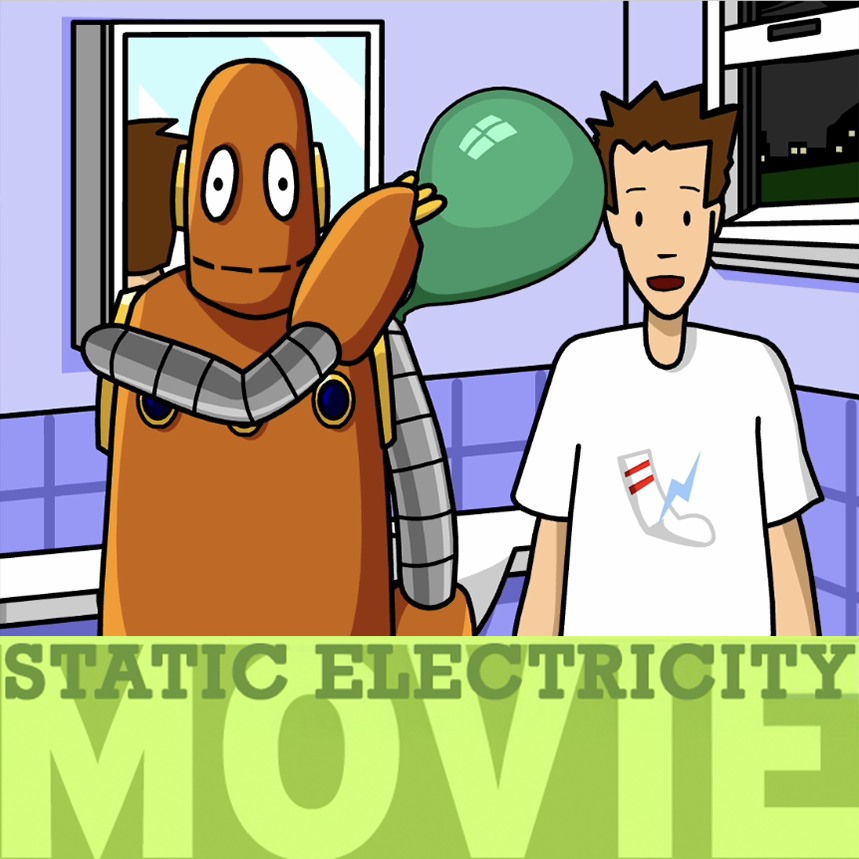
The lights come back on and the scene shows Moby rubbing a balloon against Tim's hair.
TIM: <squeak> <squeak> Ah. Right now, Moby's building up an electric charge.
Moby keeps rubbing the balloon on Tim's head while Tim addresses the camera.
TIM: The rubbing makes the balloon pick up electrons from my hair, giving it a negative charge.
The camera zooms in to show the balloon rubbing against Tim’s hair. An animation shows four circles, each labeled "e", in Tim’s hair start moving toward the balloon, eventually entering the inside the edge of the balloon. Text that appears inside the balloon reads: minus sign.
TIM: Because my hair loses those negatively-charged electrons, it gets a positive charge. Text that appears inside Tim’s hair reads: plus sign.
TIM: And the negatively-charged balloon attracts the positively-charged hairs on my head. The balloon moves away from Tim's head, causing the hair to be pulled in the same direction.
TIM: 'Cause opposites attract, right?
Moby is holding the balloon above Tim's head and Tim's hair is being pulled towards it.
MOBY: Beep!
The lights on Moby's chest light up and he lifts the balloon up higher above Tim's head, pulling his hair farther.
TIM: Uh, I think it looked better before.
Tim looks at his hair in the mirror.
TIM: Anyway, all the matter in the universe is made up of atoms.
Tim and Moby address the camera. Tim's hair is standing straight up.
TIM: And every atom contains a certain number of protons, neutrons, and electrons.
An animation shows the structure of an atom. A cluster of yellow and orange spheres are circled by several blue circles moving in circular orbits. To the left of the diagram an animation adds an orange sphere, a yellow sphere below it, and a smaller blue circle below them to represent a proton, neutron, and an electron, respectively.
TIM: Protons have a positive charge, and electrons have a negative charge.
A plus sign is added to the orange sphere and a minus sign is added to the smaller blue circle.
TIM: Neutrons don’t have any charge at all.
The yellow ball moves closer to the camera and then goes back to its original position.
TIM: So, when an atom contains the same number of protons and electrons, it has no overall charge and it's considered neutral. Protons and neutrons are stuck in the nucleus of the atom.
An image of a cluster of protons and neutrons is shown.
TIM: But electrons orbit the nucleus, kind of like the moon orbits the earth.
The camera zooms out and an animation adds electrons moving in evenly spaced circular orbits around the cluster of protons and neutrons.
TIM: And electrons like to move around. In fact, if you rub two non-conductive materials against one another, those electrons can jump from one material to the other!
MOBY: Beep?
The lights on Moby's chest light up and he looks over at Tim.
TIM: What are non-conductive materials? Well, conductors are materials that electrons flow through easily.
An animation shows a line consisting of blue dots moving through the center of a thin metal cylinder. Text at the bottom right reads: conductors.
TIM: Metals are good conductors.
<clank, clank>
Moby bangs himself on the head with his hand.
TIM: Non-conductive materials, or insulators, don’t allow electrons to flow through them. An animation shows a rubber duck floating in water. Small blue circles representing electrons accumulate on the bottom of the duck where it touches the water without passing through it. Text reads: insulators.
TIM: They include things like cloth, rubber, and plastic.
The camera zooms out to show a beach, a towel on the sand, plastic sunglasses placed on the towel, and a plastic tub full of water with the rubber duck floating on the surface.
MOBY: Beep?
The lights on Moby's chest light up.
TIM: Some insulators like to give up electrons, and some of them like to collect electrons. Most carpets are made of nylon and wool.
An animation shows a carpet on the floor. A cross section of a portion of the carpet is magnified to show individual fibers.
TIM: Those substances tend to give away their electrons, leaving them positively charged. Within the magnified portion of the carpet, blue dots representing electrons move upward and away from the carpet fibers.
TIM: Your shoes, on the other hand, have rubber soles, and rubber is a material that naturally collects electrons.
The scene changes to show a close-up of Moby's shoes. They have white rubber soles with small blue circles representing electrons accumulating on them.
TIM: Remember how the rubber balloon pulled electrons away from my hair? Well, your rubber soles can pull electrons away from the carpet. All you have to do is walk across it, and the electrons will be pulled out of the carpet and onto the soles of your shoes.
An animation shows the movement of the shoe in slow motion as Moby takes a step. Electrons are shown to leave the carpet and accumulate on the sole of the shoe.
TIM: A force called "adhesion" is responsible for the transfer of electrons. You can build up a bigger electric charge by rubbing your feet against the floor. The more you do it, the more electrons your shoes will collect.
An animation shows Moby rubbing one of his feet on the carpet. Electrons accumulate on his shoe until the entire shoes is covered in blue dots.
MOBY: Beep, beep?
TIM: Anyway, those electrons that your shoes pull away from the carpet stay stuck to the surface of your body. And if you touch a conductor, like a metal doorknob, the electrons will flow out from your body and into that conductor!
An animation shows Moby walk towards the door, extend his hand towards the door knob, but then pull it back in hesitation.
TIM: And they'll do it really, really fast!
The scene changes to show Moby’s face. The corners of his mouth move to form a frown.
TIM: The shock you feel when you touch a doorknob is millions of electrons flowing between you and the knob in, like, a split-second. That's a lot of energy to transfer in a really short time, which is why shocks can be painful.
The scene changes to show Moby's face. His eyes move back and forth from the doorknob. He then looks at the camera and blinks.
TIM: So if your home has carpeting, be careful when you’re wearing shoes indoors. Right, Moby?
Tim addresses the camera and then looks at Moby.
TIM: Moby?
An animation shows Moby move his had to touch the doorknob.
MOBY: Beep.
<zap, zap>
An animation shows Moby’s finger touching the door knob. He gets shocked and flies up in the air.
TIM: Well, at least no one can see my hair now.
An animation shows the outside of the house and the lights going out inside.



 Feedback